 By
By 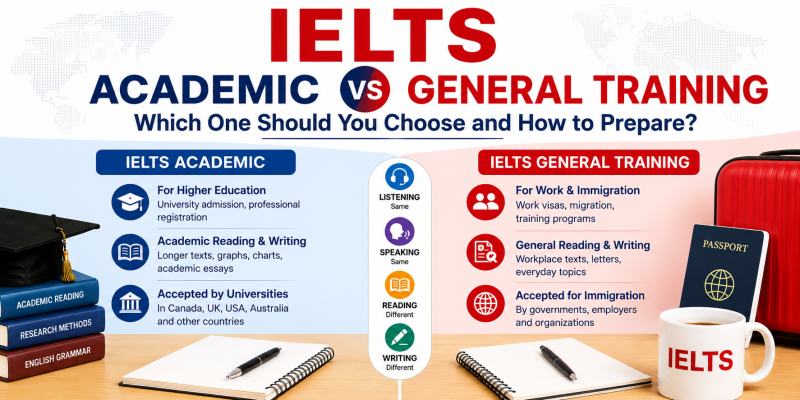
The IELTS Academic test is conducted for university admissions and professional registration for medicine and nursing. IELTS General Training is used for skilled worker visas, immigration, and work-based applications. Both tests have the same speaking and listening sections, but different reading and writing tasks 1.
The band scores from both tests are internationally recognized, but for different purposes. Universities abroad in Canada, UK, USA, Australia, and other countries are accepting academic tests, and general training tests are accepted for work or training purposes.
Choosing the wrong test can make costly mistakes. So you have to know the difference between the IELTS General Training and IELTS Academic with purpose, band score, and understand how they differ section by section to choose the right test.
What is IELTS Academic?
IELTS Academic is for students who want to pursue their studies abroad. If you want to apply for abroad colleges or universities, then this is a test for you. It focuses on formal and academic English. The reading passages are longer and more complex.
It evaluates whether you have fluent English to handle the academic environment, read complex material, and write formal assignments abroad.
What is IELTS General Training?
IELTS General Training is for people who want to work, migrate, or settle abroad. It focuses on your everyday English used in real situations. Its reading section includes the notices, advertisements, and workplace-related tests.
Its writing section is more practical. In this, you are asked to write a letter, such as a request, a complaint, or a job-related communication. It evaluates your English knowledge to handle daily communication in an abroad country.
IELTS Academic vs General Training: The Difference Table
Both IELTS Academic and General Training tests last for 165 minutes and use the 0–9 band scale. The Listening (40 questions) and Speaking (3 parts) sections are the same. But reading and writing are different. Here are the differences
| Factor | IELTS Academic | IELTS General Training |
| Purpose | Professional registration and university admission | Work visas, Migration, secondary education, training programs |
| Reading texts | 3 long academic passages (700–900 words each), 40 questions | 2 short workplace/everyday passages + 1 longer general-interest passage, 40 questions |
| Writing Task 1 | Describe a chart, graph, table, diagram, or process (150 words) | Write a letter — formal, semi-formal, or informal (150 words) |
| Writing Task 2 | Formal essay on academic topic (250 words) | Argumentative essay on an everyday topic (250 words) |
| Listening | Same (40 questions, 30 min) | Same (40 questions, 30 min) |
| Speaking | Same (11–14 min – 3 Parts) | Same (11–14 min – 3 Parts) |
| Difficulty (Reading) | Higher difficulty because of academic register, abstract topics | Lower Difficulty, basic workplace English |
| Band scale | 0–9 | 0–9 (same) |
Choosing Between IELTS Academic and General Training
To choose the right test between the IELTS Academic or General Training, you should understand the official requirements of your university, professional body, or immigration authority. Their requirements are final; no strategy or preparation can override them. Here is the simple guide on when to choose the IELTS Academic or General Training
1. University & Higher Education
If you’re applying for a bachelor’s, master’s, or PhD program, you need IELTS Academic. It tests your ability to understand complex academic texts, write analytical essays, and follow lectures—what universities expect.
2. Professional Registration
Fields like nursing, medicine, architecture, engineering, or law require the IELTS Academic for registration. These professions need a strong grasp of technical language and formal communication.
3. Immigration or PR
If you are applying for PR or through the immigration programs like Canada’s Express Entry, Australia’s Skilled Migration, or UK work visas, then you will require the IELTS General Training. It assesses your everyday English skills for living and working abroad.
4. Work or Vocational Training
If you are applying for job applications, work visas, or non-degree vocational courses, then you must choose General Training. It focuses on your practical English, like emails, instructions, forms, and basic workplace communication.
How to Prepare for IELTS Academic and General Training
Here are the tips to follow to prepare for the IELTS Academic and General Training test
1. Understand Your Goal
Confirm whether you require the IELTS Academic or General Training by understanding the university, employer, and immigration requirements.
2. Master Listening and Speaking Skills
Master in speaking and listening skills with consistent practice. You should practice English daily through podcasts, interviews, and conversations. The speaking and listening sections are the same for both modules, so you don’t need to practice separately.
3. Prepare for Academic Reading
To prepare for an academic test, you should practice reading the most. It is suggested to read journals, research articles, and educational magazines regularly to boost comprehension, vocabulary, critical thinking, and reading speed.
4. Prepare for General Training Reading
You should also focus on general training and reading practice. For this, you must practice reading advertisements, brochures, workplace notices, and newspapers, and build your skimming, scanning, and practical information-finding skills.
5. Focus on Academic Writing
To improve your academic writing score, you should practice describing graphs, charts, trends, comparisons, and processes. It builds a strong vocabulary and leads to a higher score.
6. Focus on General Training Writing
To ace the IELTS general training test, you should focus on the writing part. It is suggested to practice writing formal, semi-formal, and informal letters and understand the tone, format, greetings, and appropriate closing statements.
7. Take Regular Mock Tests
Practice the full-length IELTS mock test under timed conditions to improve your time management skills. It improves speed, stamina, accuracy, confidence, and test performance.
8. Improve Time Management
Use your time wisely during practice sessions to avoid spending too long on challenging questions during the exam.
9. Use Official IELTS Resources
You must study from the official IELTS materials to understand exam patterns, question types, marking criteria, and high-scoring answer formats. It builds your confidence in the real exam and helps you score higher.
10. Follow A Consistent Study Routine
Make a consistent study schedule to prepare for the IELTS Academic and IELTS General training tests. It is suggested to set time aside daily for reading, listening, writing, and speaking practice to gradually improve your score.
Conclusion
Choosing between IELTS Academic and IELTS General Training depends on your goals. If you want to study at a university or seek professional registration, then IELTS Academic is the right choice for you. If your goal is immigration, work, or vocational training, then IELTS General Training is right for you.
Make sure to check the requirements of your university, employer, immigration program, or professional organization before registering for any IELTS test. Once you select the right test, you should create a structured study plan, practice regularly, and improve your core language skills.
FAQs
Q1. Is IELTS Academic or General better?
Ans: It depends on your purpose and goals. Choose IELTS Academic for university admissions and professional registration in English-speaking countries. Choose IELTS general training for work visas, immigration, and secondary education purposes.
Q2. Which IELTS test is easier, Academic or General?
Ans: General training is an easier test than academic, in the reading and writing module. But remember that both tests require strategic preparation to get the desired band score.
Q3. Can I use IELTS Academic for PR?
Ans: No, IELTS Academic is not used for PR purposes. It is only for university admissions. So always check the official requirements before booking any test.
Q4. Is IELTS General accepted by universities?
Ans: No, a general training test is not accepted by universities. The international universities still require the IELTS Academic.
Q5. Can I change my test type on exam day?
Ans: No, you can’t change the test type on your exam day. you must specify Academic or General Training while booking the test, and cannot change it later.




Comments