 By
By 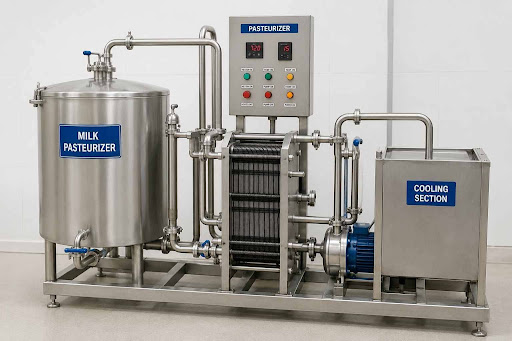
If you’ve started shopping around for a milk pasteurization machine, you’ve probably noticed something already: there are a lot of manufacturers out there, and most of their websites say pretty much the same thing. “Best quality.” “Trusted by 1000+ clients.” “World-class technology.” It gets hard to tell who’s actually good and who’s just good at marketing.
This is a decision that sticks with you for years, not months. The machine you buy will run every single day, handle raw milk that needs to be safe for people to drink, and either make your life easier or become a constant headache. So it’s worth slowing down and actually thinking through what separates a solid manufacturer from a risky one.
Here’s what I’d actually look at.
Start with how long they’ve actually been doing this
Not “how long has the company existed” — how long have they specifically been building Milk Pasteurization Machine Manufacturers equipment. Some manufacturers dabble in dairy machinery as one line among many products (mixers, packaging equipment, whatever else). Others live and breathe milk processing.
The second kind tends to build better machines, honestly. They’ve already made the mistakes, fixed the design flaws, and figured out what actually breaks down in real dairy operations. That experience shows up in small details — the way pipes are routed, how easy the machine is to clean, how well it holds temperature under real-world conditions rather than lab conditions.
Ask them directly: how many years have you been manufacturing pasteurizers specifically, and how many units have you installed? A confident manufacturer will answer this without hesitation.
Do they actually offer different types of machines?
There isn’t one “correct” pasteurizer for every dairy. A small farm producing a few hundred liters a day has completely different needs than a commercial plant running thousands of liters an hour.
Broadly, you’re choosing between:
- Batch pasteurizers, which heat milk in a tank and hold it at temperature for a set time — good for smaller volumes and simpler operations
- HTST (High Temperature Short Time) systems, which run milk continuously through a heat exchanger — better suited for larger, ongoing production
- Smaller or mobile units, useful if you’re farm-based or just starting out and don’t need a full commercial setup yet
A manufacturer worth working with will ask about your volume, your milk type, and your future plans before recommending anything. If they push one model on everyone regardless of what you actually need, that’s a bit of a red flag.
Look closely at what the machine is actually made of
This part matters more than people realize. Milk is sensitive — it picks up flavors, reacts with certain metals, and any rough surface or seam becomes a place where bacteria can hide. So the material and finish quality aren’t just technical specs, they’re food safety issues.
Good manufacturers use food-grade stainless steel (usually SS304 or SS316) for anything that touches milk. The welds should be smooth, not rough or pitted. Ask to see the surface finish up close if you can, either in person or through detailed photos. If a manufacturer gets vague or defensive when you ask about material grades, take that as a sign to look elsewhere.
Certifications aren’t just a checkbox
ISO certification, FDA compliance, CE marking, FSSAI approval — depending on where you’re located and where you’re selling, one or more of these will apply to you. These aren’t just stickers a manufacturer slaps on their website. They mean someone independent actually reviewed the design, materials, and manufacturing process.
Ask for the actual certificates, not just a mention of them in a brochure. A legitimate manufacturer will hand these over without making it complicated.
How much of the process is automated?
Older or cheaper pasteurizers sometimes rely on manual monitoring — someone watching a gauge and adjusting things by hand. That works, but it leaves more room for human error, and it’s harder to prove consistent compliance if you ever get audited.
Better machines today come with digital controls that monitor temperature and holding time automatically, log the data, and trigger an alarm (or shut down) if something goes off track. It’s worth asking what kind of control system the manufacturer uses and whether you can pull reports from it later. This becomes genuinely useful once you’re dealing with Food Processing Machinery safety inspections.
What happens after you buy it?
Here’s something people tend to overlook until it’s too late: the sale is just the beginning. Machines need maintenance. Parts wear out. Something will eventually go wrong, usually at an inconvenient time.
Before you commit to a manufacturer, find out what their support actually looks like. Do they help with installation, or do you figure that out on your own? Is there someone local you can call, or will you be waiting weeks for a technician to fly in? How fast can they get you spare parts? Will they train your staff to operate and clean the machine properly?
A manufacturer that disappears after the invoice is paid can cost you far more in downtime than you saved on the purchase price.
Don’t let price be the only thing you compare
It’s tempting to just line up quotes and go with the cheapest one. But price without context doesn’t tell you much. A lower number might mean thinner steel, no installation support, a shorter warranty, or a machine that eats more electricity every month for the next ten years.
When you’re comparing options, ask what’s actually included — installation, training, warranty coverage — and think about the total cost over the machine’s life, not just what you pay on day one. Sometimes the “expensive” option is actually cheaper once you factor in fewer breakdowns and lower running costs.
Talk to people who’ve already bought from them
Reviews on a website are curated, obviously. What’s more useful is asking the manufacturer directly for a couple of existing customers you can talk to, ideally ones with a similar production scale to yours.
A quick call with someone who’s been using the machine for a year or two will tell you more than any spec sheet. Ask them how often it’s broken down, how responsive support has been, and whether they’d buy from the same manufacturer again.
Can they build around what you actually need?
Every dairy setup is a little different — different milk types, different space constraints, different growth plans. A manufacturer that only offers rigid, fixed configurations might not be able to grow with you. If you’re planning to scale up production in a couple of years, it’s worth asking upfront whether the equipment (or the manufacturer’s product line) can accommodate that.
Putting it all together
There’s no single “best” manufacturer that fits every business — what matters is finding one whose experience, build quality, and support match what your operation actually needs. Spend a bit of extra time on this before you sign anything. Ask the uncomfortable questions, ask for proof instead of promises, and talk to real customers if you can.
A pasteurization machine bought carefully, from a manufacturer who actually stands behind it, will quietly do its job for years. One bought in a hurry, based on the lowest price alone, has a way of becoming a problem you think about far more often than you’d like.


Comments