 By
By 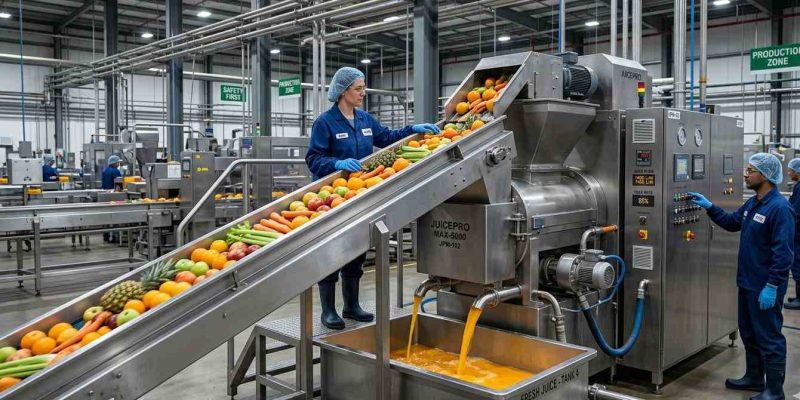
In the food and beverage industry, machines play a very important role in fast and smooth production. Businesses need equipment that can handle large quantities, save time, and give good quality output.
Two commonly used machines in this industry are the Industrial Juice Extractor Machine and the Industrial Blender.
At first, both machines may look similar because they process fruits and vegetables. But in reality, they work in very different ways and give different results.
If you are planning to set up or upgrade a food processing unit, this guide will help you understand the difference in a very simple way.
What is an Industrial Juice Extractor Machine in the Food Processing Industry?
An industrial juice extractor machine is used to take out juice from fruits and vegetables in large amounts. It separates juice from pulp, seeds, and fiber.
It is mainly used in juice factories and beverage industries where clear juice is required.
How It Works
The machine crushes or presses fruits and vegetables. Then it separates liquid juice from solid waste like pulp using filters or a spinning system. The juice is collected, and the pulp is removed separately.
Key Output
- Clear liquid juice
- Less fiber
- Clean separation of pulp
- Ready for packaging or storage
What is an Industrial Blender?
An industrial blender is a machine that mixes everything together. It does not separate juice and pulp.
It is used in food processing industries to make thick mixtures like smoothies, sauces, soups, and purees.
How It Works
It uses fast-moving blades that mix and crush all ingredients together until they become smooth and thick.
Key Output
- Thick mixture
- Full fiber included
- Smooth and even texture
- Ready for food preparation
Juice Extractor Machine vs Blender: Key Differences
Now let’s understand the main differences in a very simple way.
1. Texture and Consistency
The biggest difference is the final texture of the product. An industrial juice extractor machine gives a thin, smooth, and clear juice. It separates juice from pulp, seeds, and fiber efficiently. This juice feels light and is easy to drink.
An industrial blender makes a thick and heavy mixture. It mixes everything together, including fiber and pulp. So, if you want clear juice, use a juice extractor. If you want a thick drink or paste, use a blender.
2. Fiber Content
Fiber is handled differently in both machines. A juice extractor removes fiber and gives only liquid juice. So the drink is smooth but low in fiber. A blender keeps all the fiber inside the drink. So the result is thicker and more filling.
In simple words:
Juice extractor = no fiber
Blender = full fiber
3. Production Efficiency
Both machines are used for large-scale production, but their work style is different. Juice extractors are best for making juice in bulk. They separate juice and pulp quickly, which helps in beverage production.
Blenders are best for mixing food ingredients fast and evenly. They are used when full mixing is required. So, juice extractors are better for juice production, while blenders are better for food mixing.
4. Versatility
Blenders are more useful for different types of work. A juice extractor machine is mainly used for juice only.
A blender can make many things like smoothies, soups, sauces, purees, and shakes. So, a blender is more flexible in daily food processing work.
5. Waste Production
A juice extractor separates juice and leaves behind pulp. This pulp becomes waste or can be reused for other purposes.
A blender uses the full fruit or vegetable. So there is almost no waste. This makes blenders more efficient in using raw materials fully.
6. Ease of Cleaning
Cleaning is also different for both machines. A blender is easy to clean because it has fewer parts.
A juice extractor has more parts like filters and containers, so it takes more time to clean. So, blenders are more simple and quick to maintain.
7. Speed and Convenience
A blender works faster because you just add ingredients and blend them quickly.
A juice extractor takes more time because it separates juice, collects pulp, and then needs cleaning. So, for quick daily use, blenders are more convenient.
Juice Extractor Machine vs Blender: Quick Comparison
| Feature | Juice Extractor | Blender |
| Texture | Filtered clear juice | Homogeneous thick mixture |
| Fiber | Fiber removed | Fiber retained |
| Application | Juice production | Food mixing & processing |
| Waste Output | Pulp waste generated | Minimal waste |
| Ease of Cleaning | Moderate maintenance | Easy cleaning |
| Versatility | Limited use | High versatility |
| Best For | Beverage industry | Food industry |
Industrial Applications
Both machines are used in different industries depending on the product type.
Juice Extractor Machine Uses
- Juice manufacturing plants
- Beverage production industries
- Packaged juice factories
- Fruit processing units
Blender Uses
- Smoothie production
- Sauce and puree making
- Soup processing
- Dairy and food mixing industries
Simple understanding:
Juice Extractor = Juice production
Blender = Food mixing and preparation
Which One Should You Choose?
Your choice depends on what you want to produce.
Choose Industrial Juice Extractor Machine if:
- You make fruit juices
- You need clear liquid output
- You work in beverage industry
- You want pulp separation
Choose Industrial Blender if:
- You make smoothies or sauces
- You need thick food mixtures
- You want full ingredient use
- You need a multi-purpose machine
Conclusion
Both machines serve distinct roles in the food and beverage industry. Industrial juice extractors are ideal for producing clear, filtered juice at scale, while industrial blenders are better suited for creating thick, fiber-rich mixtures for diverse food applications.
The right choice depends on your production requirements, product type, and processing goals. Selecting the appropriate machine can significantly improve efficiency, product consistency, and overall operational output.



Comments