 By
By 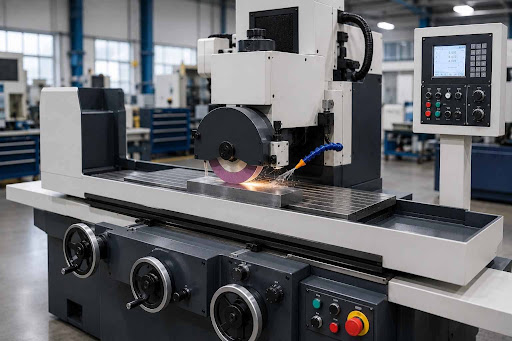
Buying a surface grinder is easy to get wrong in two directions. Spend too little and you’re stuck with a machine that can’t hold tolerance on your actual parts. Spend too much and you’ve bought CNC repeatability for jobs that never needed it. This guide is meant to help you land in the middle — matched to what you actually grind, not what a sales sheet makes look impressive.
What an Automatic Surface Grinder Actually Does
It removes material with a rotating abrasive wheel to produce a flat, precise surface — same as a manual grinder. The difference is that once it’s set up, the machine controls table travel, cross feed, and the grinding cycle itself. You’re not standing there cranking handles and eyeballing passes; you’re monitoring and adjusting.
That matters more than it sounds. Manual grinding quality depends heavily on operator skill and fatigue — the tenth part of a shift often isn’t as clean as the first. An automatic surface grinder machine removes that variable almost entirely.
The Features That Actually Affect Your Results
Not every spec on a brochure matters equally. Here’s what to weigh, and why:
1. Table feed and cross feed automation
This is the baseline function, not a bonus feature. If a machine you’re looking at doesn’t have reliable auto cross-feed indexing, it’s not really an “automatic” grinder in the way you probably mean.
2. Hydraulic vs. servo drive
Hydraulic systems are the traditional choice and tend to be cheaper to maintain long-term, but servo-driven systems give tighter control and are increasingly standard on newer machines. If you’re grinding tight tolerances (under 0.0005″) on hardened materials, servo control is worth the premium.
3. DRO + PLC controls
A digital readout alone gets you accurate depth and position feedback. Add PLC controls and you can program repeatable cycles instead of resetting parameters by hand for every job change. If your shop runs the same parts repeatedly, PLC pays for itself fast. If you’re doing one-off tool room work, it may be more than you need.
4. Magnetic chuck table
Electromagnetic chucks let you release parts instantly and adjust holding force; permanent magnetic chucks are simpler and cheaper but less flexible for delicate or oddly shaped workpieces. Know which one your work actually requires before you buy.
5. Coolant system
Don’t treat this as an afterthought. Inadequate coolant flow is one of the most common causes of thermal distortion and wheel loading on hardened steel. If you’re working hardened alloys regularly, check flow rate and filtration, not just “yes it has coolant.”
6. Safety interlocks and guarding
Increasingly regulated depending on your region; confirm the machine meets your local workplace safety standards before purchase, not after installation.
The Buying Decision, Step by Step
1. Define your actual tolerance requirement.
Don’t buy for the tightest tolerance you might someday need — buy for what you regularly run, with reasonable headroom. Overspeccing here is the single biggest way shops waste budget.
2. Match table size to real parts, not aspirational ones.
Check both maximum table size and weight capacity — shops often check one and forget the other, then find their heaviest fixtures exceed the machine’s rated load.
3. Decide manual/hydraulic vs. CNC honestly.
CNC earns its cost on repeat, complex geometries. If you’re mostly doing flat surface work on varied one-off parts, a hydraulic machine with good DRO may outperform a CNC machine on cost-per-part.
4. Check wheel head specs against your materials.
Spindle speed and motor power need to match what you’re actually cutting — a machine underpowered for hardened alloys will burn wheels and struggle on finish quality regardless of how good its other specs are.
5. Ask about parts lead time before you ask about price.
A slightly more expensive machine from a supplier with fast regional parts support is almost always cheaper over 5 years than a discount machine where a broken part means a 6-week wait.
6. Get service history from other buyers, not just the sales rep.
If possible, talk to another shop running the same model for 2+ years. Warranty terms tell you what the manufacturer promises; other owners tell you what actually happens.
Where These Machines Earn Their Keep
Automotive components, tool and die work, mold making, aerospace finishing, precision instruments — any application where “close enough” creates real downstream cost (rework, scrap, failed assembly).
Final thought
The right automatic surface grinder is the one sized to your actual tolerance needs, your actual part volume, and your actual maintenance capacity — not the one with the longest feature list. Match the machine to the work first, and the ROI takes care of itself.

Comments