 By
By 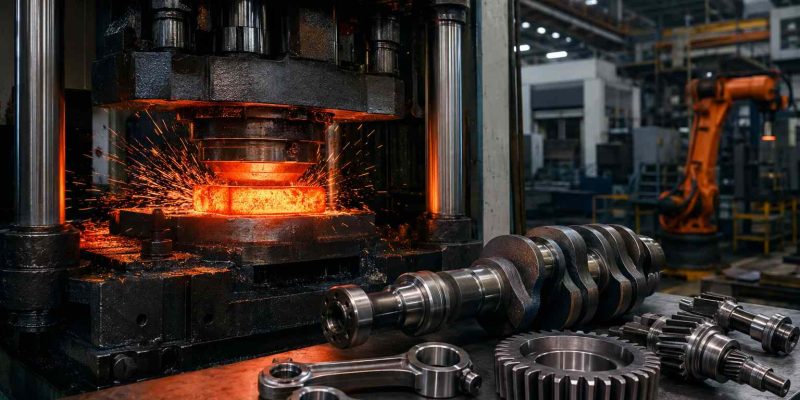
Introduction
In modern manufacturing, metal forming processes play a critical role in producing strong, precise, and durable components. Industries like automotive, aerospace, oil & gas, and heavy machinery depend heavily on forged parts for safety and performance. Among all forging techniques, closed die forging is often considered one of the most advanced and efficient methods.
But how does it really compare with other metal forming processes? Which method delivers the highest strength, reliability, and long-term performance?
In this blog, we will break down closed die forging vs other methods, helping you understand which process is more powerful and why it matters in real-world applications.
What Is Closed Die Forging?
Closed die forging, also known as impression die forging, is a metal shaping process where heated metal is placed between two dies that contain a pre-designed shape. When pressure is applied, the metal flows and fills the die cavity, forming a precise and strong component.
This process is widely used to manufacture:
- Automotive parts (crankshafts, gears, connecting rods)
- Aerospace components
- Industrial tools
- Heavy machinery parts
The biggest advantage of closed die forging is its ability to produce high-strength, near-net-shape components with excellent accuracy.
Understanding Other Metal Forming Methods
To properly compare closed die forging, it is important to understand other commonly used manufacturing processes.
1. Open Die Forging
Open die forging involves compressing metal between flat or simple-shaped dies without fully enclosing it. The operator manually controls the shape by repeatedly hammering or pressing the metal.
Advantages:
- Suitable for large components
- Flexible for simple shapes
- Cost-effective for low-volume production
Limitations:
- Lower dimensional accuracy
- Requires additional machining
- Not suitable for complex shapes
2. Casting
Casting is a process where molten metal is poured into a mold and allowed to solidify into a desired shape.
Advantages:
- Can produce complex geometries
- Suitable for large-scale production
- Cost-effective for intricate designs
Limitations:
- Lower mechanical strength compared to forging
- Possibility of internal defects like porosity
- Less fatigue resistance
3. Machining
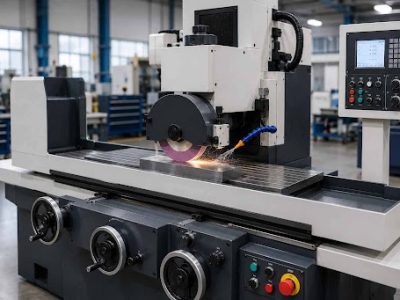
Machining is a subtractive process where material is removed from a solid block using cutting tools to achieve the final shape.
Advantages:
- Extremely high precision
- Ideal for tight tolerances
- Good surface finish
Limitations:
- High material wastage
- Slower production rate
- Expensive for mass production
4. Powder Metallurgy
This process involves compressing metal powders into a shape and then heating them to form a solid part.
Advantages:
- Minimal material waste
- Suitable for small, complex parts
- Good repeatability
Limitations:
- Lower strength compared to forging
- Limited to smaller components
- Not suitable for heavy-load applications
Closed Die Forging vs Other Methods: Key Comparison
1. Strength and Structural Integrity
Closed die forging significantly improves the internal grain flow of metal, aligning it with the shape of the part. This results in exceptional strength and resistance to fatigue.
In contrast, casting may contain internal voids, and machining does not improve the internal structure of the material.
Result: Closed die forging offers the highest strength and durability among all methods.
2. Precision and Dimensional Accuracy
Closed die forging produces near-net-shape components that require minimal finishing. The use of precision-engineered dies ensures consistency across large production runs.
Machining offers high precision but wastes material, while casting often requires post-processing to achieve accuracy.
Result: Closed die forging provides a strong balance of precision and efficiency.
3. Material Efficiency
Material efficiency is a major concern in manufacturing. Machining removes large amounts of raw material, leading to waste. Casting can also involve excess material trimming.
Closed die forging, on the other hand, uses material more efficiently by shaping it under pressure rather than cutting it away.
Result: Closed die forging is more material-efficient than machining and casting.
4. Production Speed and Scalability
Once dies are created, closed die forging is highly efficient for mass production. It allows manufacturers to produce large volumes of identical components quickly.
Casting is also scalable, but quality consistency can vary. Machining is slower and not ideal for large-scale production.
Result: Closed die forging is highly efficient for high-volume manufacturing.
5. Design Flexibility
Casting offers the highest flexibility for complex internal geometries, which forging processes cannot easily achieve due to material flow limitations.
Result: Casting is more flexible for complex shapes, but less strong.
Why Closed Die Forging Is Considered More Powerful
When we refer to a process as “more powerful” in manufacturing, we are not only talking about physical force but also about performance, strength, reliability, and efficiency.
Closed die forging stands out because it:
- Enhances grain structure for maximum strength
- Eliminates internal defects such as porosity and voids
- Improves fatigue resistance for long-term durability
- Ensures consistent quality in mass production
- Reduces the risk of component failure under extreme stress
These characteristics make it especially suitable for critical engineering applications where safety and performance cannot be compromised.
Applications of Closed Die Forging
Closed die forging is used in many industries where very strong and long-lasting metal parts are needed. It makes parts that can handle heavy pressure, heat, and daily use without breaking.
Automotive Industry
Automotive applications include forged components such as engine parts, gears, axles, and connecting rods. These components operate under high pressure and mechanical stress. Forging makes them strong so they last longer.
Aerospace Industry
Airplanes use this process for parts like landing gear, body parts, and engine parts. These parts must be strong but also light so the plane can fly safely.
Oil and Gas Industry
In oil and gas work, machines work in very hard conditions. Forging is used to make valves, drilling tools, and high-pressure parts. These parts must be very safe and strong.
Construction and Heavy Machines
Big machines like excavators, loaders, and cranes use forged parts. These machines lift heavy loads, so their parts must be strong and not break easily.
Railway Systems
Trains use forged parts like wheels, axles, and connectors. These parts carry heavy weight and run for long distances, so they must stay strong for a long time.
Advantages of Closed Die Forging Over Other Methods
To summarize the benefits:
- Superior mechanical strength
- Better fatigue resistance
- High consistency in production
- Reduced material wastage
- Long service life of components
- Ideal for critical applications
These advantages clearly explain why industries prefer closed die forging for high-performance parts.
Limitations of Closed Die Forging
Despite its strengths, closed die forging also has some limitations:
- High initial cost of die design and tooling
- Not suitable for very complex internal geometries
- Requires specialized equipment and skilled operation
However, these limitations are often outweighed by the long-term benefits in quality and performance.
Conclusion
When comparing closed die forging vs other methods, it becomes clear that each manufacturing process has its own purpose. Casting is best for complex shapes, machining is ideal for precision, and powder metallurgy works well for small components.
However, when it comes to maximum strength, durability, consistency, and performance under extreme conditions, closed die forging emerges as the most powerful and reliable method.
This is why it remains a backbone of modern manufacturing industries where failure is not an option and performance is everything.


Comments