 By
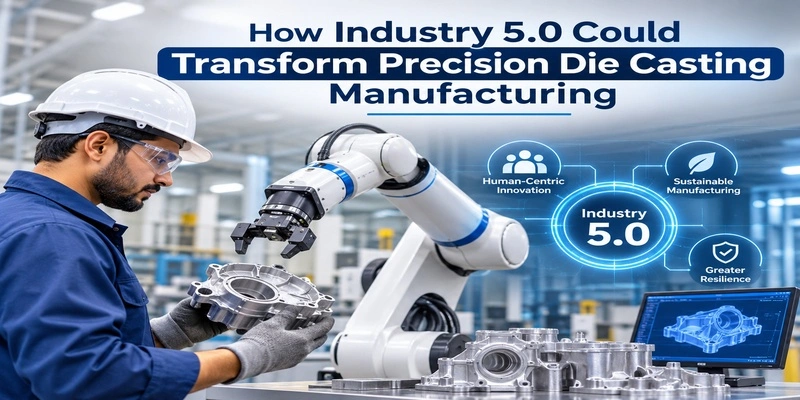
Why putting people and smart technology side by side may shape the next era of the die casting manufacturing industry
Precision die casting has always been a mix of heat, pressure, and skill. Molten metal is pushed into a steel die in seconds, and the result is a strong, accurate part that can be made again and again.
Over the past decade, the industry has added automation, sensors, and data to this process. Now a new idea is gaining attention: Industry 5.0. Instead of focusing only on faster machines, it asks how technology can work with people, protect the environment, and make supply chains more resilient.
In this article, we explain what Industry 5.0 means in simple terms, and how it could change die casting manufacturing for manufacturers, designers, and buyers.
What Is Industry 5.0?
Industry 4.0 brought connected machines, automation, and data to the factory floor. It focused on speed, efficiency, and smart systems.
Industry 5.0 builds on that work, but shifts the focus. It is often described around three ideas:
- Human-centric: People and technology work together, and skilled workers stay at the centre of decisions.
- Sustainable: Manufacturing uses less energy, creates less waste, and reuses more material.
- Resilient: Factories and supply chains can handle disruption and adapt quickly.
In short, Industry 4.0 asked, “How can machines do more?” Industry 5.0 asks, “How can machines and people do better work together?”
Why It Matters for Precision Die Casting
Precision die casting is a process where small changes make a big difference. A slight shift in metal temperature, injection speed, or die condition can affect how a part looks and performs.
This makes die casting a natural fit for smarter, more connected manufacturing. At the same time, it still depends heavily on experienced people. Die designers, process engineers, and quality inspectors bring judgement that no machine fully replaces.
Industry 5.0 aims to combine both strengths: the speed and consistency of technology, and the experience of skilled people.
6 Ways Industry 5.0 Could Change Die Casting Manufacturing
1. Smarter Collaboration Between Workers and Machines
In many die casting plants, workers handle heavy or repetitive tasks near hot equipment. Collaborative robots, often called cobots, can take over jobs like part handling, spraying, or trimming, while people focus on setting up, checking, and improving the process.
This can make the workplace safer and let skilled staff spend more time on work that needs judgement.
2. AI-Assisted Quality Inspection in Die Casting Manufacturing
Quality control is central to precision die casting. Vision systems and AI tools can help spot surface defects, flash, or missing features faster than manual checks alone. Combined with methods such as dimensional measurement and X-ray inspection, they give a fuller picture of part quality.
The key idea in Industry 5.0 is support, not replacement. Inspectors still review unusual results and decide what action to take.
3. Digital Twins and Simulation
A digital twin is a virtual model of a part, a die, or even a whole production line. Before cutting steel, engineers can use simulation to see how metal will flow and cool inside the die. This helps predict problems like porosity, shrinkage, or warping.
For buyers, this can mean fewer die changes, shorter development time, and better first samples. For manufacturers, it means learning from the virtual world before spending on the real one.
4. Predictive Maintenance
Dies and machines wear over time. Sensors can track temperature, pressure, and vibration, and software can flag signs of wear before a failure happens. Instead of reacting to breakdowns, teams can plan maintenance at the right time.
This helps protect part quality, reduce downtime, and extend the life of expensive tooling.
5. Greener Aluminium Die Casting Manufacturing
Sustainability is a core part of Industry 5.0. Aluminium is well suited here because it can be recycled, and scrap from the casting process can often be remelted and reused.
Beyond recycling, manufacturers can look at:
- Energy-efficient furnaces and machines
- Better process control to reduce scrap and rework
- Heat recovery and waste reduction programmes
- Lightweight die-cast components that help products use less energy in use, such as in electric vehicles
Buyers also increasingly ask suppliers about their environmental practices, so these efforts can become a real business advantage.
6. More Flexible and Resilient Production
Customers today want shorter lead times, smaller batches, and quick design changes. Connected systems and better planning tools can help die casting companies switch between jobs faster and respond to changes in demand.
Industry 5.0 also encourages resilience, which means having backup plans for materials, tooling, and logistics. A resilient supplier is easier to trust when conditions change.
What This Means for Buyers and Designers
You do not need to be a technology expert to benefit from these changes. When choosing a die casting manufacturer, you can ask practical questions that show how far a supplier has come.
- Do you use simulation before building the die?
- How do you monitor process conditions during production?
- What inspection methods do you use, and can you share sample reports?
- How do you plan maintenance for dies and machines?
- What steps do you take to reduce scrap and energy use?
- How do your people and technology work together on quality?
Clear, confident answers are a good sign. Vague answers may mean the supplier is still relying on older methods.
Challenges to Keep in Mind
Industry 5.0 is a direction, not a switch that flips overnight. Manufacturers face real challenges along the way.
- Cost: New equipment, software, and training need investment, which can be hard for smaller companies.
- Skills: Workers need training to use new tools well, and the industry needs to attract new talent.
- Data quality: Smart systems are only as good as the data they receive.
- Integration: New tools must work with existing machines and processes.
The companies that succeed are usually those that start small, choose clear goals, and involve their people from the beginning.
The Road Ahead
It is still early, and not every die casting plant will adopt these ideas at the same speed. But the direction is clear. Customers want high precision, lower environmental impact, and dependable supply. Workers want safe, meaningful jobs. Technology can help deliver all of these when it is used with care.
For the die casting industry, this is a chance to grow in a balanced way: smarter machines, skilled people, and cleaner processes working as one system.
Final Thoughts on Die Casting Manufacturing in Upcoming Industry
Industry 5.0 does not replace the craft of precision die casting. It strengthens it. By pairing human experience with smart tools, manufacturers can improve quality, cut waste, and respond faster to customer needs.
If you are sourcing die-cast components, it is worth asking how your suppliers are preparing for this shift. The ones investing in people, technology, and sustainability together are likely to be the partners who deliver reliable parts for years to come.


Comments