 By
By 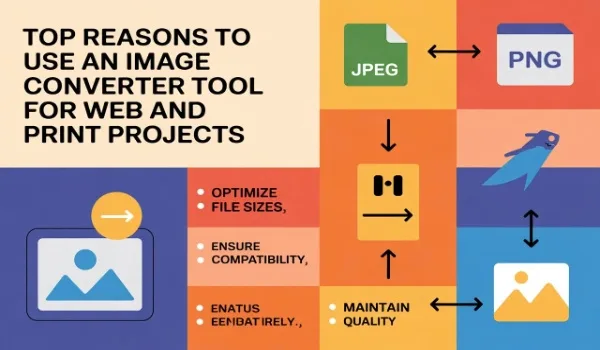
Images are the core of how we communicate today. It does not matter if you are developing a website, creating the marketing material, or getting the files ready for printing, the image format is the determining factor in the quality and the performance of work.
Still, various platforms require different formats. What is perfectly fine for the web might not work for print and the other way round as well. This is exactly the point where an Image Converter Tool is very helpful.
Instead of altering images from the beginning or battling with format errors, you can simply and positively adjust your files.
TL;DR / Quick Answer
An Image Converter Tool allows you to convert images to the correct formats for online and printing, thus ensuring compatibility, quality, and faster workflows without the need for technical skills.
1. Ensures the Right Format of Image Converter Tool
The requirements of web and print projects differ substantially. Websites look for the light formats in order to have the pages load fast, whereas print requires high-resolution images for sharpness and color accuracy.
With an Image Converter Tool you can:
Change images to WebP or JPG that are suitable for use on the Internet
Make PNG or TIFF files ready for printing
Modify formats without creating a new one
The aforementioned adaptability guarantees that your visuals will be effective at any place.
Learn how format precision leads to better results of the project.
2. Improves Website Performance and User Experience
Bulky and unsupported images will make your website slow. A slow website would increase the user’s probability of leaving it and would decrease the engagement. Search engines also prefer websites that load faster.
With an Image Converter Tool, you can easily turn your images into the right formats that save space and thus makes your files smaller without any visible loss to quality. In line with Google Web.dev, correctly-sized images significantly speed up the loading of the page and this in turn results in better rankings and user satisfaction.
Performance is not optional for online projects, it is a must.
3. Maintains High Quality using Image Converter Tool
Printed materials are supposed to have sharp details,correct colors, and high resolution. The use of incorrect formats may cause pixelation, color shifting, and blurred text.
An Image Converter Tool facilitates the task of converting print images into friendly formats while maintaining quality. So, this gives the assurance that the brochures, banners, and catalogs would look attractive and elegant.
You get to keep the clarity of the image without the need for complicated editing tools.
4. Simplifies Workflow for Designers and Marketers
Handling different image formats in a manual way takes up a lot of your time. Designers are frequently overwhelmed with different versions of the file for online, printing, and social media. Marketers, on the other hand, require fast turnarounds for their campaigns.
The work of an Image Converter Tool is to make this workflow efficient by:
- Lessening the manual editing steps
- Doing away with the need for extra software
- Allowing speedy format changes whenever desired
The effectiveness in this way enables the team to be on time in delivering the work and at the same time they do not compromise the quality.
Discover how the simplified conversion process frees up your schedule and energy.
5. Reduces File Size Without Losing Visual Impact
One of the major concerns when doing image conversion is the loss of image quality. A good Image Converter makes an effort to keep a balance between compression and clarity. Web projects, in particular, benefit from this, as smaller file sizes mean faster loading.
The tool thus preserves resolution and color even for print. You get the best of both worlds—optimized files for the web and high-quality visuals for print.
6. Supports Multiple File Formats in One Place
Web and print projects are mostly a combination of various formats. JPG, PNG, WebP, TIFF, and BMP all have different uses. The need to switch between tools for each format will slow you down.
An Image Converter is capable of handling several formats on a single platform which means that you can convert your images whenever you want and you do not have to learn different software.
This integrated way lessens the difficulty and keeps your workflow in order.
7. Enhances Compatibility Across Devices and Software
Different devices and software have different ways of handling image formats. An image that appears correct on one device may not be the same on another.
Here are some features you need in a reliable pic converter tool:
- Browsers and operating systems
- Content management systems
- Printing software and publishing tools
So there is less chance of mistakes and the output will be consistent.
8. Saves Time and Costs on Rework
Often, the cause of rework is the use of wrong image formats, which may entail resizing, reformatting, or recreating visuals. It takes time and increases costs.
An Image Converter enables you to do it right the first time by setting the format according to the project’s requirement. It will be very useful, in particular, for businesses that manage multiple campaigns or publications.
Rework can be reduced and efficiency can be improved across the projects.
FAQs
1. What format is ideal for print projects?
Generally, TIFF and high-quality PNG are the best formats for print because of their clarity.
2. Does image conversion affect quality?
If done properly, the conversion will maintain the quality and only optimize the file size.
3. Is online image conversion reliable?
Definitely. Tools that are trustworthy ensure that the processing is done securely and the original quality is kept.



Comments